


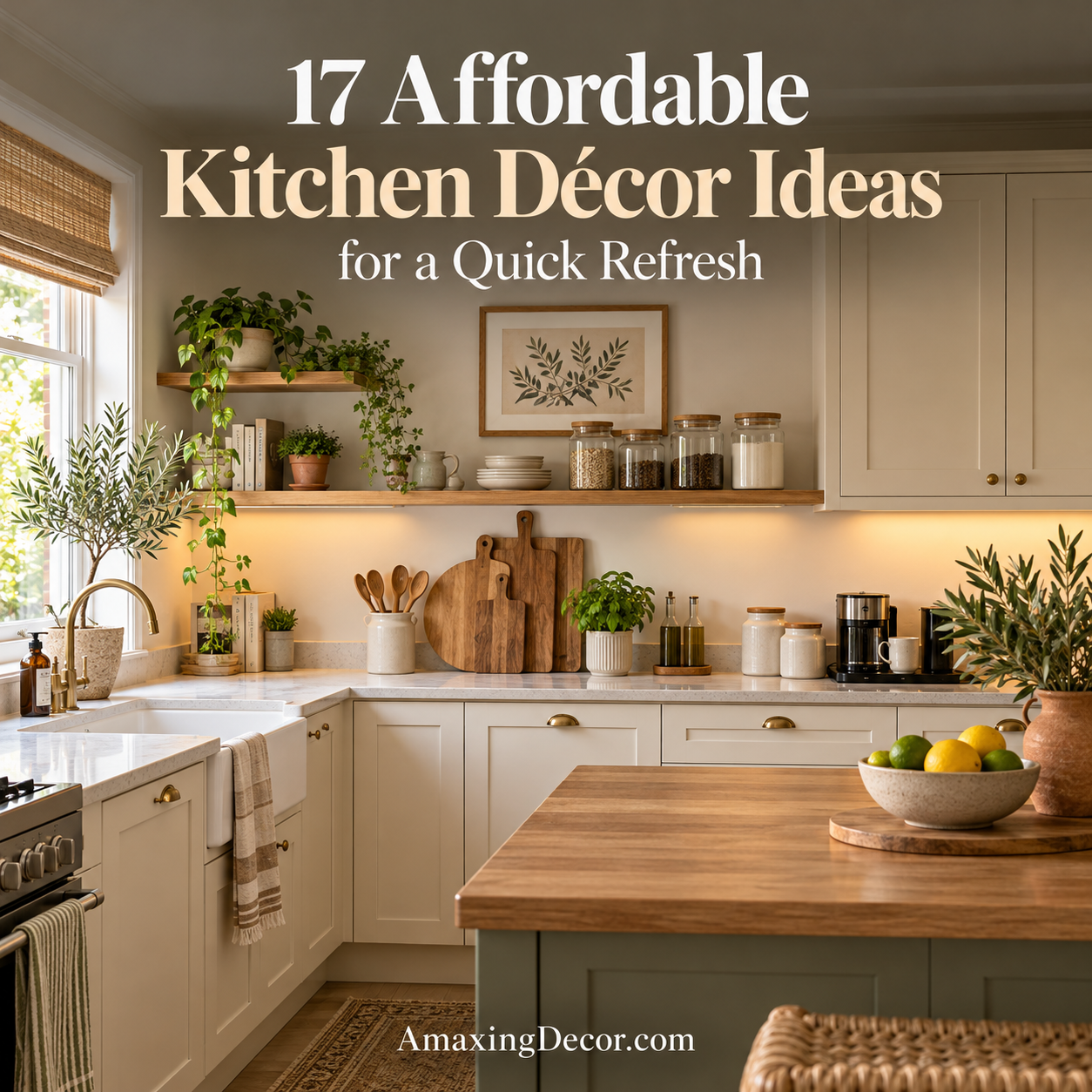
A kitchen does not need a full renovation to feel fresher, warmer and more personal. Small changes to lighting, colour, storage and the objects already on display can transform the room without replacing the cabinets, worktops or appliances.
The most effective affordable kitchen decor ideas are not about filling every surface with accessories. They improve the overall view of the room while keeping cooking areas safe and easy to clean. A new wall colour, a better-organised open shelf or a single attractive lamp can make more difference than a collection of small decorative purchases.
This guide contains 17 realistic ways to refresh a kitchen on a budget. Some cost nothing beyond time and effort, while others require only paint, fabric, hardware or a carefully selected second-hand find. There are also options for small kitchens and rented homes where permanent changes may not be possible.
Plan your affordable kitchen refresh first
Before buying anything, stand at the entrance and take a photograph of the kitchen. A photograph often reveals visual clutter, empty walls and mismatched elements that are easy to overlook in daily life.
Ask yourself:
- Which area catches my eye first?
- Which objects are permanently left on the worktop?
- Does the room lack colour, warmth or light?
- Are open shelves useful or overcrowded?
- Which finishes already need to remain?
- Is there one feature I can improve instead of changing everything?
Set a clear budget and divide it between essentials and decoration. If a light fitting is unsafe, a tap leaks or a cupboard hinge is broken, deal with the practical issue before buying artwork and accessories.
Choose one simple direction for the refresh. For example:
- Warm white, olive and natural wood
- Cream, navy and aged brass
- Soft grey, dusty blue and pale timber
- White, black and terracotta
- Mushroom, burgundy and dark wood
Repeating a limited group of colours and materials will make inexpensive changes look more considered.
1. Declutter and restyle the worktops
The quickest kitchen refresh may cost nothing. Worktops naturally collect appliances, post, food containers, cleaning products and items waiting to be put away. Removing what is not used daily gives the kitchen more visual space.
Begin by emptying one section at a time. Clean the surface, then return only the objects that genuinely need to remain. Store rarely used appliances in an accessible cupboard rather than allowing them to dominate the room.
Group smaller everyday items on a tray. A wooden or washable tray can hold cooking oil, salt and pepper near the preparation area, while another may organise tea and coffee supplies. The tray creates a clear boundary and makes the group easier to move when cleaning.
Keep a generous area free for food preparation. Decorative objects should never reduce the kitchen’s usefulness or sit where they can be contaminated by raw food, splashes or heat.
Budget tip: Shop the home before buying organisers. A shallow serving tray, ceramic dish or unused basket may already suit the space.
2. Paint one wall or a small architectural feature
Paint changes a large area for relatively little money. You do not need to repaint the entire kitchen. A single wall, alcove, chimney breast, breakfast corner or section above panelling may be enough.
Choose a finish suitable for a kitchen, considering wipeability, moisture and the condition of the surface. Prepare the wall carefully; filling small holes and cleaning grease will improve the result more than an expensive tin of paint applied over a poor surface.
Warm neutrals such as cream, putty, oatmeal and mushroom are easy to live with. Olive, muted blue, terracotta or deep green can create a stronger feature. Test the colour in several places and view it during the day and under the kitchen’s artificial lighting.
If the cabinets already have a strong colour, select a wall tone that complements them. White cabinets suit almost anything, while cream units often look better with warm rather than blue-based neutrals.
Budget tip: Small feature areas may require only a tester-size or small tin, but confirm that the product is appropriate for the surface and location.
3. Replace or paint cabinet handles
Cabinet handles are small, but they repeat across the room and therefore have a strong visual effect. Changing shiny chrome handles to black, brass, bronze or timber can alter the kitchen’s character without replacing the doors.
Measure the distance between existing screw holes before buying. Choosing handles with the same centres avoids drilling new holes and makes the update easier to reverse.
If the current handles are a suitable shape but the finish looks dated, they may be cleaned or refinished using a product intended for the material. Remove them before painting, prepare them properly and allow the finish to cure fully before refitting.
Do not paint hinges, catches or moving parts unless the product is specifically suitable. A thick layer of paint can interfere with operation.
Budget tip: Count every handle before ordering and buy one sample first. A bargain pack is not good value if it feels uncomfortable or does not cover the old fixing marks.
4. Create an organised tea or coffee station
A small drinks station turns everyday supplies into a useful display. Choose a section of worktop close to the kettle or coffee machine and group the items that are used most often.
You might include:
- Tea, coffee or cocoa in labelled containers
- Everyday mugs on a shelf or mug tree
- Sugar or sweeteners in a lidded jar
- Spoons in a small pot
- A washable tray beneath the group
- A small framed print on the wall behind
Keep the arrangement compact. Too many jars, signs and decorative mugs will create clutter rather than convenience. Store excess supplies in a cupboard and refill the display as required.
Position cables safely and keep electrical appliances away from water. Do not place shelves or decorations where steam from the kettle will repeatedly reach them.
Budget tip: Use matching jars you already own and create simple labels rather than buying a complete branded storage set.
5. Style open shelves with useful objects
Open shelves work best when they contain items that are both attractive and regularly used. Instead of treating them as purely decorative, display bowls, mugs, glasses, cookbooks and storage jars.
Begin by removing everything. Sort the contents into groups by function and colour, then return fewer items with space between them. Place heavier pieces lower down and keep frequently used objects within comfortable reach.
Create rhythm by repeating colours. Three blue-and-white pieces spread across two shelves will look more connected than one blue object among many unrelated colours. Mix vertical books, stacked bowls and a taller jug to vary the height.
Avoid displaying anything that is difficult to clean in a greasy or dusty part of the kitchen. Shelves close to the hob need especially careful consideration.
Budget tip: Turn attractive everyday crockery into the display instead of purchasing accessories that serve no practical purpose.
6. Add affordable kitchen wall art
Wall art introduces colour without taking up worktop space. Vintage food illustrations, botanical prints, typography, family photographs, landscapes and abstract designs can all work in a kitchen.
Choose art that complements the home rather than relying on generic kitchen slogans. A kitchen is still part of the wider interior, so artwork does not have to feature cutlery, coffee or recipes.
For an affordable gallery wall, combine:
- Printable artwork
- Postcards or small textiles
- Pages from damaged vintage books that can be reused legally
- Family recipes copied and framed
- Children’s artwork in coordinated frames
- Photographs of places or food with personal meaning
Use frames in one or two finishes to unite different images. Keep art away from direct heat, heavy steam and areas where food or water will splash.
Budget tip: Refresh existing frames with new prints or paint rather than buying an entirely new collection.
7. Introduce colour through kitchen textiles
Tea towels, seat pads, blinds, washable runners and table linens offer an inexpensive way to change the palette. Because they are easy to replace, textiles are useful for seasonal updates.
Select two or three coordinated colours rather than buying unrelated patterns. A striped tea towel might provide the palette for plain seat cushions and a small runner. If the cabinets and walls are neutral, textiles can introduce olive, rust, navy, ochre or burgundy.
Keep fabrics clean and away from hobs, open flames and appliances that produce heat. Tea towels should have a designated hook or rail instead of being draped over handles close to cooking areas.
In an open-plan kitchen, repeat one textile colour in the living or dining area to connect the zones.
Budget tip: Cushion covers and simple table runners can sometimes be made from leftover washable fabric, provided the maker has suitable sewing skills.
8. Improve the lighting
Better lighting can make existing colours and finishes look entirely different. Kitchens need clear task lighting for preparation, along with softer light for dining and evening use.
Review each layer:
- General lighting illuminates the whole room.
- Task lighting supports work at counters, the sink and cooking areas.
- Accent lighting adds atmosphere around shelves or dining spaces.
A shaded pendant over a table can make a breakfast corner feel more intentional. A small rechargeable lamp may work on a shelf or sideboard if it is designed for that use and kept away from water and heat. Under-cabinet lighting can improve work surfaces, but permanent electrical installation should be handled appropriately.
Use a consistent bulb colour within connected spaces. Warm-white light creates a softer evening mood, while preparation areas still need enough brightness and accurate visibility.
Budget tip: Before replacing fittings, check whether changing incompatible, mismatched or overly cool bulbs gives the room the improvement it needs.
9. Add a washable runner or small rug
A runner can soften hard flooring, introduce pattern and visually lengthen a narrow galley kitchen. In a larger room, a small rug may define a breakfast or dining area.
Choose a durable, low-profile and easy-to-clean design. The rug must lie flat and should not interfere with doors, stools or working routes. Use an underlay suitable for the rug and floor.
Avoid placing loose rugs immediately beside the hob or anywhere spills create an unacceptable slip or fire risk. A washable mat in a carefully chosen position may be more practical than a decorative deep-pile rug.
Budget tip: Measure the space before shopping. A discounted rug is not affordable if it blocks a door or looks too small for the area.
10. Display wooden boards and practical utensils
Wooden boards bring warmth to white, grey and high-gloss kitchens. Group two or three boards of different heights against a wall in a dry preparation area. Their shapes create an easy layered display while keeping them accessible.
A ceramic pot can hold a small selection of frequently used wooden spoons and utensils. Avoid cramming every tool into it; store less attractive or rarely used pieces in a drawer.
Clean and maintain boards according to their material and care instructions. Do not use decorative boards for food preparation unless they are food-safe and in suitable condition.
Budget tip: Restyle the boards and utensils already in the kitchen before purchasing decorative versions.
11. Refresh the window area
A kitchen window often becomes a collection point for bottles, cleaning products and miscellaneous objects. Clear the sill, clean the glass and decide what genuinely belongs there.
A simple blind, café curtain or washable window treatment can soften the space and provide privacy. Select material suitable for the kitchen environment and keep it away from flames, heat and sinks where necessary.
Use the sill for one restrained group, such as:
- Two or three herb pots
- A shallow ceramic planter
- Coloured glass bottles
- A small framed print
- One vase with seasonal stems
Do not block useful daylight. Tall plants and crowded accessories can make a small kitchen darker.
Budget tip: Moving existing plants into coordinated outer pots can give the window a more finished appearance at little cost.
12. Use plants and fresh herbs
Plants add life and natural colour to a kitchen. Herbs may also be useful, but they need the right amount of light, water and ventilation.
Choose species according to the actual conditions. A bright windowsill may suit certain herbs, while a darker corner requires a plant tolerant of lower light. Keep foliage away from hobs, food-preparation surfaces and extreme temperature changes.
Use simple pots in a repeated colour or material. Terracotta adds warmth, while white ceramic feels clean and understated. Place pots on saucers or inside watertight covers to protect the surface beneath.
Check that plants are suitable for homes with children and pets. Remove unhealthy plants instead of allowing damaged leaves and spilled soil to make the kitchen look untidy.
Budget tip: Divide suitable existing plants or grow herbs from seed rather than buying several mature plants.
13. Update storage jars and labels
Visible food storage can look decorative when it is consistent and genuinely useful. Transfer suitable dry goods into airtight, food-safe containers only when this improves storage and identification.
Clear jars work well for ingredients such as pasta, rice or oats, but they should be labelled with the contents and any information your household needs. Retain cooking instructions, allergen details and expiry information where relevant.
Do not decant products merely for appearance if it creates confusion or affects safe storage. Keep containers clean, dry and suitable for food use.
For a coordinated look, use one label style and a limited range of jar shapes. Leave some shelf space empty so the collection remains easy to manage.
Budget tip: Reuse suitable glass jars after removing labels and cleaning them thoroughly. Replace damaged lids and avoid containers that are not intended for repeated food storage.
14. Restyle the kitchen table or breakfast nook
A small dining area can become the warmest part of the kitchen with only a few changes. Begin by clearing paperwork and unrelated items, then create a low everyday centrepiece.
Ideas include:
- A bowl of fruit
- A small vase of seasonal stems
- A pot of herbs
- A ceramic jug
- A tray holding salt, pepper and napkins
- One battery-operated lamp designed for indoor use
Add washable seat cushions if the chairs are hard, or use a simple runner to introduce colour. Keep the arrangement low enough for conversation and easy to move when the table is needed.
A framed picture or narrow shelf on the adjacent wall can help the nook feel intentional rather than like leftover space.
Budget tip: A bowl and vase already owned can be rotated seasonally with fruit, greenery or garden cuttings.
15. Add a peel-and-stick update carefully
Removable wallpaper, vinyl and tile-style products can change a small area quickly. They may suit the back of a display cupboard, a pantry wall, a dry alcove or another low-risk surface.
These products are not appropriate everywhere. Heat, steam, water and grease can affect adhesion and safety. Confirm that the product is designed for the exact location, surface and temperature conditions. It should not be placed where the manufacturer prohibits it, including behind certain hobs or close to open flames.
Prepare the surface exactly as directed and test a discreet area. In a rented home, check the tenancy conditions and understand that some supposedly removable products can still lift paint or leave residue.
Use pattern on a limited area so it looks like a considered feature rather than an attempt to cover every surface.
Budget tip: A small cupboard interior or breakfast-nook panel requires less material and is easier to reverse than an entire kitchen wall.
16. Create attractive, practical storage
Storage becomes part of the décor when it is visible. Baskets, hooks, rails and boxes can reduce clutter while introducing texture and repetition.
Possible improvements include:
- A basket for clean tea towels
- A tray for post and keys away from food preparation
- Matching boxes above cabinets, if safely accessible
- Hooks for aprons and reusable bags
- A wall rail for suitable lightweight tools
- A lidded container for pet supplies
- Dividers inside drawers to keep worktops clearer
Avoid hanging objects directly over the hob or preparation surfaces where they may fall or collect grease. Wall-mounted storage must be fixed appropriately for the wall and expected load.
If the tops of cabinets are used, keep items contained and do not store anything heavy where it is difficult to lift safely.
Budget tip: Improving hidden storage can create a bigger visible change than buying decorative containers for the worktop.
17. Create one seasonal focal point
A kitchen can reflect the season without being filled with themed decorations. Choose one location—a table, shelf, windowsill or sideboard—and update it with a restrained arrangement.
For winter, use stoneware, a wooden board, a bowl of pears and a small arrangement of evergreen or bare branches. Spring might introduce potted bulbs and pale textiles, while summer could use herbs, glass and fresh fruit. Autumn suits rust, olive, apples and dried seed heads.
Keep the arrangement away from food preparation, heat and water. Natural materials should be clean, non-toxic and suitable for households with children or pets.
For more cold-season styling ideas throughout the home, read The Complete Winter Home Décor Guide for a Cosy Home.
Budget tip: Reuse the same tray, vase and bowl throughout the year, changing only the natural material or textile colour.
How to refresh a small kitchen on a budget
Small kitchens benefit from visual order more than additional decoration. Keep the palette limited and avoid filling worktops with organisers that reduce usable space.
Prioritise:
- Clearing counters and improving drawer storage
- Using wall space carefully without overcrowding it
- Keeping the window and main sightline open
- Choosing one wall colour and one accent colour
- Adding lighting beneath cabinets or around the dining area where appropriate
- Displaying only attractive, regularly used items
- Using matching containers in modest numbers
- Selecting a narrow, secure runner if the layout allows it
Vertical storage can help, but it must be easy to reach and safely fixed. Store heavy objects at a comfortable height rather than placing them on high shelves for appearance.
A small room often looks more expensive when there is visible space between objects. Do not feel obliged to fill every wall, shelf and corner.
Affordable renter-friendly kitchen décor
Renters can update the kitchen through movable items and reversible styling:
- Change tea towels, table linen and seat pads
- Add art using permitted fixing methods
- Introduce a freestanding trolley if space allows
- Use plug-in or rechargeable lighting suitable for the location
- Restyle open shelving and worktops
- Add a washable runner with a suitable underlay
- Use trays, jars and baskets that can move to the next home
- Replace handles only with permission and retain the originals
- Use removable products only after checking the tenancy and surface
Do not alter fixed electrics, plumbing, ventilation or gas appliances. Report defects to the landlord or agent and obtain permission before making changes that affect the property.
How to make an inexpensive kitchen refresh look cohesive
Affordable does not have to look random. Use repetition and restraint to give separate updates a shared identity.
Repeat the same metal finish
If the main fixtures are chrome, repeat chrome or a compatible silver finish in a few details. If you introduce brass handles, relate them to a frame or lamp without attempting to make every metal identical.
Limit the colour palette
Use one dominant neutral and one or two accents. Repeating the same olive or navy across art, textiles and ceramics creates cohesion.
Mix old and new deliberately
A vintage wooden stool can work beside modern cabinets when another timber object repeats its warmth. One old piece feels special; many unrelated pieces may feel accidental.
Choose larger, useful objects
A generous bowl, framed artwork or wooden board often has more impact than several miniature signs and ornaments.
Leave breathing room
Empty space is part of the composition. Clear areas make practical objects look more intentional and keep the kitchen easy to clean.
Common budget kitchen decorating mistakes
Buying accessories before decluttering
New storage and decoration will not improve a kitchen if the main problem is too much visible clutter. Edit first and buy later.
Choosing style over safe food preparation
Worktops must remain hygienic and functional. Keep décor away from raw-food areas, hobs, sinks and places exposed to repeated splashing.
Following a trend that clashes with fixed finishes
The cabinets, flooring and worktops occupy most of the visual space. Choose additions that work with them rather than forcing a fashionable colour or metal finish into the room.
Using too many word signs
One typographic print can be playful. A room filled with signs often looks cluttered and less personal than art, photographs or collected objects.
Applying unsuitable adhesive products
Peel-and-stick products vary greatly. Check surface, heat and moisture requirements and do not assume every product is safe behind a hob or near a sink.
Forgetting maintenance
Open shelves, plants, rugs and displays all require cleaning. Choose an amount you can maintain easily.
Making permanent changes in a rented home
Obtain permission and keep the original fittings where appropriate. A reversible idea is only successful if it actually leaves the surface undamaged.
A quick kitchen refresh by budget
| Approximate budget | Priorities |
|---|---|
| Almost no cost | Declutter worktops, rearrange shelves, move art and accessories from other rooms, clean windows and regroup everyday items |
| Under £25 | New tea towels or cushion covers, a plant, printable art, labels, a tray or small amount of paint for a feature |
| Under £50 | Cabinet handles, a runner, several coordinated frames, a larger plant or improved bulbs where compatible |
| Under £100 | A substantial rug, lined blind or curtain, feature-wall paint, pendant shade or a second-hand trolley or small table |
These figures are only planning guides. Prices vary by product, room size and location. Measure carefully and prioritise quality where safety, durability or daily use matters.
Frequently asked questions
How can I decorate my kitchen cheaply?
Start by decluttering and restyling what you already own. Add colour through tea towels, art and a small amount of paint. Group everyday objects on trays and display attractive crockery, boards or jars instead of buying purely decorative accessories.
What is the cheapest way to update kitchen cabinets?
Cleaning the doors thoroughly and changing or refinishing compatible handles may provide the simplest update. Painting doors is a larger project that requires the correct preparation, products and permission if the home is rented.
How can I make an old kitchen look better without renovating?
Work with the fixed finishes. Improve lighting, refresh wall colour, organise worktops, update textiles and introduce repeated accents through art, handles and ceramics. Repair visible damage rather than trying to hide it with decoration.
What can I put on kitchen walls?
Framed prints, photographs, a clock, shallow shelves and suitable wall-mounted storage can all work. Keep them away from areas exposed to flames, heavy steam, grease or water, and use appropriate fixings.
How do I decorate kitchen worktops without creating clutter?
Keep only frequently used items visible and arrange them in small functional groups. Use a tray for oils and seasonings or create a compact drinks station. Leave a large clear area for food preparation.
How can I make a small kitchen look more expensive?
Limit the colour palette, keep surfaces clear, choose a few substantial accessories and repeat finishes. Consistent lighting, neatly fitted window treatments and well-maintained hardware often create more impact than numerous ornaments.
Are peel-and-stick tiles suitable for kitchens?
Only use a product approved for the exact surface and location. Heat, steam, grease and water can affect performance, and some products are unsuitable near hobs. Follow the manufacturer’s installation and clearance instructions.
What colours make a kitchen feel warm?
Cream, oatmeal, mushroom, warm taupe, olive, terracotta, rust and muted burgundy create warmth. Timber and warm-white lighting can also soften kitchens dominated by white, grey, metal or stone.
How can renters refresh a kitchen?
Use movable textiles, art, plants, lamps, trays and storage. Restyle shelves and worktops, and consider a freestanding trolley. Seek permission before replacing handles, applying adhesive finishes or altering fixed elements.
How often should kitchen décor be updated?
There is no need for frequent redesign. Keep the main palette and useful pieces consistent, then make small seasonal adjustments through textiles, plants and one focal display. Review clutter and storage whenever the kitchen becomes difficult to use.
Refresh the kitchen without overdecorating it
An affordable kitchen update is most successful when it improves both appearance and everyday use. Begin with clear worktops, better organisation and lighting that supports cooking. Then add colour and personality through a few well-chosen textiles, useful objects and pieces of art.
You do not need all 17 ideas. Choose three or four that address the kitchen’s most visible weaknesses. A painted feature wall, updated handles, warm lighting and a restyled shelf may be enough to make the entire room feel different.
By working with the cabinets and surfaces already in place, repeating a simple palette and leaving space around each addition, you can create a kitchen that feels fresh and coordinated without the cost and disruption of a full renovation.


