


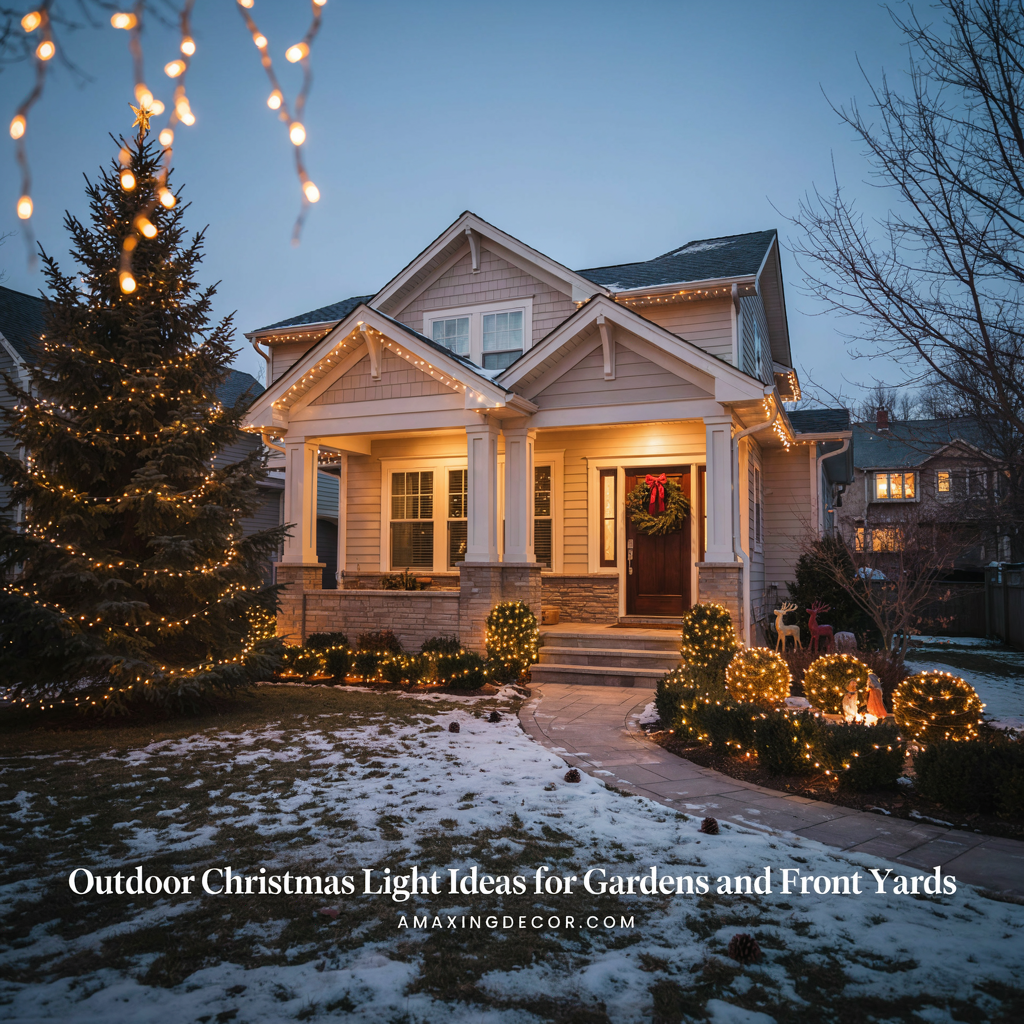
Outdoor Christmas lights can make a home feel welcoming before guests even reach the front door. A softly lit tree, warm entrance garland or clear line of pathway lights can transform a dark winter garden without covering every surface.
The most successful displays begin with a plan. Outdoor lighting needs suitable products, safe power, secure fixings and cable routes that remain clear of doors, paths and standing water. It also needs to suit the scale of the property. A restrained display can look more polished—and be easier to maintain—than several unrelated colours and flashing patterns competing at once.
This guide covers outdoor Christmas light ideas for front gardens, paths, porches, trees, shrubs, fences, pergolas and back gardens. It also explains how to choose colours, plan power and installation, work around UK winter weather and store the lights properly after Christmas.
Internal link: Link the introduction to The Complete Christmas Home Décor Guide: Ideas for Every Room using the anchor text Christmas home décor ideas.
Plan the display before buying lights
View the property from the pavement, driveway and main approach. Identify the features already visible after dark:
- Front door or porch
- Main windows
- Roofline or eaves
- Path and steps
- One prominent tree
- Hedges and shrubs
- Gate, fence or garden wall
- Pergola, arch or shed
- Balcony or railings
Choose one main focal point and two or three supporting areas. For example, the entrance may be the main feature, supported by one tree and a softly lit path. Lighting every available edge can dilute the effect.
Take measurements before purchasing. Estimate the length of rooflines, fences and garlands, and check the distance to suitable power. Never assume an extension cable will solve a poorly planned route.
Choose a lighting style and colour palette
Warm white
Warm-white lights create a welcoming, traditional appearance. They suit brick, timber, greenery and gold or red decorations.
Cool white
Cool white feels crisp and wintery, especially against pale render, silver decorations or frost. It can appear harsh on a warm-coloured property, so test a small section first.
Multicoloured
Multicoloured lights bring nostalgia and energy. Use one consistent colour pattern or product family to prevent the display becoming visually disjointed.
Red, green and warm white
This classic combination works when each colour has a clear role. Use warm white as the foundation, with red and green in one wreath, tree or focal feature.
Blue and white
Blue and white produce a cool winter effect. Keep the blue concentrated rather than mixing it with several other bright colours.
Champagne and amber
Champagne or amber tones feel softer and more elegant than very bright white. They pair well with natural foliage, copper planters and traditional homes.
Understand outdoor product suitability
Only use lights, transformers, plugs, extension equipment and connectors intended for their exact location and conditions. Indoor lights should remain indoors.
Check the product instructions for:
- Indoor or outdoor rating
- Permitted exposure to rain
- Transformer placement
- Maximum number of connected sets
- Cable and connector requirements
- Timer and control suitability
- Fixing guidance
- Operating temperature
- Whether a socket or connection must remain covered or sheltered
IP ratings can indicate protection against solids and moisture, but the complete product instructions still matter. Do not select equipment from one rating number alone. If fixed exterior electrics or new sockets are required, use a competent electrician.
1. Frame the front door with warm-white lights
The entrance is the most useful focal point because it welcomes visitors and can be enjoyed every evening. Add a suitable lighted garland around the door or illuminate planters on either side.
Keep lights and foliage away from hinges, locks, doorbells, letterboxes and the door swing. Attach decorations with fixings suited to the surface and outdoor conditions.
A symmetrical arrangement suits formal entrances, while one fuller garland running up one side and across the top creates a relaxed modern effect.
2. Add a lighted Christmas wreath
A wreath with a small integrated battery-light set creates impact without a long cable. Select lights and a battery compartment intended for exterior use.
Hide the compartment within the wreath while keeping it accessible. Secure the wreath using a reliable hook or hanger compatible with the door.
Avoid excessive weight and check the attachment after strong winds. The wreath should not cover the house number, peephole or door hardware.
3. Illuminate entrance planters
Fill substantial outdoor planters with evergreen foliage, branches and weather-suitable ornaments. Add compact outdoor-rated lights through the arrangement.
Use heavy, stable containers with drainage. Keep cables away from wet soil unless the product specifically permits that installation. Battery lights may simplify the arrangement when their components are suitable for outdoor conditions.
Repeat the same planter design on both sides of a wide door or use one concentrated display on the safer side of a narrow entrance.
4. Guide visitors with pathway lights
Pathway lighting should improve visibility as well as decoration. Use low stakes, lanterns or carefully positioned light strings intended for the purpose.
Keep the usable width of the path clear. Do not run cables across walking routes, steps or driveways. Lights should mark boundaries without dazzling visitors or hiding changes in level.
Decorative path lights do not necessarily replace proper functional exterior lighting. Ensure steps and entrances remain clearly visible.
5. Wrap one statement tree
A single well-lit tree can anchor the whole garden display. Wrap lights around the trunk and selected main branches rather than trying to cover every twig.
Use products and fixing methods that do not cut into or damage the bark. Leave room for movement and growth, and remove temporary lighting after the season.
Work only from ground level or suitable access equipment within your ability. Large trees, high branches and locations near overhead services require professional assessment.
6. Add net lights to a hedge
Net lights can create an even result across a dense hedge when the size fits the planting. Spread them gently and avoid forcing cables through branches.
Secure the edges against wind using product-compatible outdoor fixings. Do not leave loose sections where wildlife, people or garden tools may become caught.
Choose a consistent light colour and stop the net at a natural edge rather than leaving an incomplete bright patch.
7. Highlight individual shrubs
Use one compact light set per shrub or repeat the same treatment across a small group. This creates pools of light rather than one continuous wall.
Keep connections above standing water and follow all product instructions. Avoid pulling strings tightly around living branches.
Three shrubs lit in the same warm white can provide enough depth behind an entrance or lawn without lighting the entire boundary.
8. Outline a garden arch
A garden arch provides a natural frame for lights. Follow the shape with one controlled strand and add a small cluster of greenery at the top or side.
Check that the arch is structurally sound before attaching anything. Keep the centre height and width clear for safe passage.
Do not hang loose cable loops where clothing or bags may catch. Secure lights at regular intervals using suitable outdoor fasteners.
9. Decorate a pergola with festoon lights
Festoon lights can turn a pergola into a festive outdoor room. Run them in straight, evenly spaced lines or follow the perimeter.
Use only appropriate outdoor products and confirm that the pergola can accept the proposed fixings and load. Keep cables taut enough not to hang into head height but not under damaging tension.
Inspect the structure, roof or retractable cover before winter. Do not attach heavy equipment to beams unless the pergola was designed for it.
Internal link: Link this section to What Is a Pergola? Discover Its Benefits and Uses or the future comprehensive Pergola pillar.
10. Create a lit outdoor seating corner
Use lanterns, a small illuminated tree and overhead outdoor lights to give a sheltered seating area a Christmas atmosphere.
Keep blankets and cushions stored dry and use lighting that preserves safe routes from the house. Do not substitute decorative light for proper step or path illumination.
Avoid open flames and indoor electrical products. The area should remain properly ventilated if any approved outdoor heating equipment is used.
Internal link: Link to How to Create a Cosy Outdoor Seating Area for Autumn for broader layout and weather-preparation advice.
11. Outline a fence selectively
Rather than covering the full boundary, light the section visible behind the main display or along the entrance path. A straight, consistent line appears tidier than sagging loops.
Use surface-appropriate outdoor clips rather than nails or staples through cables. Keep lights away from gates, latches and sections that flex or move.
Consider neighbours on the opposite side before installing bright or flashing lights along a shared boundary.
12. Add curtain lights to a wall
Outdoor curtain lights can create a backdrop behind a seating area or on a plain house wall. Choose a size proportionate to the surface.
Secure the top and lower edges according to instructions so the strands do not whip in the wind. Keep windows, vents and doors operational.
Use a steady or gentle setting for a calm result. Rapid flashing across a large wall can disturb neighbours and overwhelm the rest of the display.
13. Light a shed or garden building
A shed can become a charming secondary focal point with a small wreath, lit doorway or restrained roof-edge line.
Inspect the building before attaching lights. Weak fascia boards, loose roofing and damp electrics need attention before decoration.
Do not enter or alter fixed electrical installations unless qualified. Use an appropriate power solution and preserve access to doors and locks.
14. Add stars to trees or walls
Outdoor-rated illuminated stars create clear shapes and suit modern or minimalist schemes. Hang one large star or a group of three varied sizes.
Use fixings capable of supporting the weight in wind. Keep stars away from opening windows and fragile branches.
One strong shape often looks more polished than numerous small novelty figures.
15. Use outdoor lantern groups
Place two or three substantial lanterns beside the front door, on a wide step or within a sheltered garden display. Use outdoor-rated battery candles.
Vary the height and keep the finish consistent—black metal, aged brass or timber-look designs. Weight or secure them where wind is a concern.
Do not place lanterns in the walking route or where an outward-opening door may strike them.
16. Add lights to window boxes
Window boxes can hold greenery, weather-suitable decorations and a compact light set. Keep the display low enough not to obstruct the window.
Confirm that the box and brackets are secure before adding weight. Preserve drainage and avoid placing electrical connections in wet compost.
Repeat the same design across several windows for a coordinated façade.
17. Frame ground-floor windows
Outline selected ground-floor windows with a neat border of suitable lights or place illuminated stars inside where they can be seen outdoors.
Avoid trapping cables in window frames or interfering with locks, vents and emergency escape. Interior products must remain inside, even when displayed through glass.
Use the same colour temperature as the entrance to connect the whole front elevation.
18. Create an illuminated reindeer or figure display
Use one or two substantial outdoor-rated figures on the lawn or near the entrance rather than a crowd of unrelated characters.
Anchor each figure exactly as instructed and inspect the fixings after wind. Keep cables away from paths, mowers and areas where vehicles turn.
Scale matters: a small figure may disappear on a large lawn, while an oversized piece can overwhelm a compact front garden.
19. Make a lighted branch tree
Place sturdy branches in a weighted exterior container and wrap them with suitable lights. This works in a covered porch or sheltered patio where a conventional tree would be impractical.
Secure the branches, container and cable against wind. Use clean material collected responsibly and keep the arrangement away from doors and walking routes.
If the display is exposed, confirm that every component is suitable for the conditions.
20. Decorate balcony railings safely
Check building and tenancy rules before attaching anything to a balcony. Use lights and fixings intended for exposed exterior locations.
Keep decorations on the inside of the railing where possible, and secure every component so nothing can fall. Do not trail cables through doors or across the balcony floor.
Avoid heavy garlands, unsecured planters and any installation that changes the safe height or usability of the railing.
21. Create a warm-white driveway entrance
Light the gate, entrance pillars or two substantial planters to mark the property without running lights along the whole drive.
Keep vehicle visibility clear and avoid glare at eye level. Do not place cables where tyres can cross them unless the system was professionally designed for that situation.
The house number should remain easy to read for guests, deliveries and emergency services.
22. Highlight a garden wall
Use suitable uplights, a line of stars or a restrained garland to emphasise a stone or brick wall. Grazing light across texture can be effective without adding many decorations.
Position fittings so they do not shine into windows or neighbouring homes. Fixed exterior lighting should be installed appropriately.
Remove fallen leaves and debris around ground-level fittings to maintain visibility and reduce hazards.
23. Use solar Christmas lights selectively
Solar lights can work where running power is impractical, but winter daylight and panel position affect performance. A display may glow for less time during overcast periods.
Place the panel where it receives the best available daylight and keep it free from debris. Choose the product based on realistic winter performance rather than summer expectations.
Do not rely on decorative solar lights as the only illumination for steps, paths or entrances.
24. Add projection lighting with consideration
An outdoor projector can cover a wall with moving stars or snow patterns. Position it entirely within the property and secure it against movement and weather.
Keep the projection on your own building, away from roads, drivers, neighbours’ windows and the sky. Avoid intense flashing or patterns that may cause disturbance.
Check local and property rules, use an outdoor-rated product and preserve access around the projector and cable.
25. Create a restrained back-garden display
The back garden can feel festive with one lit tree, pergola lights and several lanterns near the seating area. It does not need the same scale as the front.
Focus on features visible from the living room or kitchen. This allows the display to be enjoyed from indoors during cold or wet weather.
Use timers and turn off lighting when it is no longer needed, particularly where it may affect neighbours or wildlife.
Outdoor Christmas light ideas by property type
Terraced house
Concentrate on the front door, one ground-floor window and a narrow planter. Preserve the shared pavement and keep all cables within the property.
Semi-detached house
Use the entrance as the focal point, supported by one tree or hedge section. Consider how the scheme relates to the neighbouring half of the building.
Detached house
Choose several connected zones rather than outlining every edge. An entrance, statement tree and pathway often provide enough impact.
Flat or apartment
Decorate inside the window or on a permitted balcony. Follow building rules and do not attach items to communal areas without approval.
Cottage
Warm-white lights, simple greenery, lanterns and one star complement stone, brick and timber without hiding the architecture.
Modern home
Use clean lines, repeated geometric shapes and a limited palette. Warm white with champagne or cool white with silver can both work.
Outdoor Christmas light layouts for small front gardens
Small gardens benefit from a clear hierarchy:
- Light the front door.
- Add one low pathway or step detail.
- Choose either one shrub, one tree or one window as the secondary feature.
- Leave boundaries and rooflines simple.
Use fewer products with consistent spacing. Large numbers of small decorations make a compact garden feel cluttered and create more cables to manage.
Elegant outdoor Christmas lighting ideas
To achieve a refined result:
- Use one light colour temperature.
- Repeat the same spacing and brightness.
- Highlight architecture rather than covering it.
- Choose one statement tree or entrance.
- Limit novelty figures.
- Use symmetry where it suits the property.
- Conceal cables and transformers as permitted.
- Avoid rapid flashing effects.
- Leave some areas dark for contrast.
Elegance comes from editing. Remove the feature that competes most with the main focal point.
Budget-friendly outdoor Christmas light ideas
- Light only the front door and one tree.
- Reuse existing outdoor-rated lights after inspecting them.
- Add timers to avoid unnecessary running time where compatible.
- Use one wreath with battery lights.
- Fill existing planters with seasonal foliage and a compact light set.
- Decorate features already present, such as an arch or hedge.
- Choose solar products only where winter performance is realistic.
- Buy compatible modular sets rather than unrelated products.
- Avoid purchasing lights before measuring.
- Store everything carefully for future years.
The least expensive display is often the one installed correctly and reused safely over several seasons.
How to plan power and cable routes
Map every light set, transformer, plug and control point before installation. Keep connections where the instructions require and away from pooled water.
Do not:
- Run ordinary cables across paths or driveways.
- Trap cables in doors or windows.
- Hide electrical cables beneath outdoor rugs.
- Overload sockets or extension equipment.
- Join incompatible systems.
- Place transformers or connectors contrary to their rating.
- Improvise repairs with household tape.
If a safe route is not possible, change the display or obtain professional electrical advice.
Using timers and smart controls
Timers make the display consistent and reduce the need to go outside in poor weather. Choose controls compatible with the light set and suitable for their location.
A common approach is to switch lights on near dusk and off later in the evening. There is little benefit in leaving decorative lights operating throughout the night when no one is viewing them.
Smart controls depend on reliable connectivity and correct outdoor installation. Always retain a safe manual method of switching the display off.
Installing lights safely
Work in daylight and suitable weather
Avoid installation during rain, ice, strong wind or poor visibility.
Inspect every set
Do not use lights with damaged cables, cracked housings, loose plugs or signs of overheating.
Use the correct fixings
Choose clips designed for lights and the relevant surface. Never nail, staple or screw through electrical cables.
Work safely at height
Use suitable access equipment on stable ground and follow its instructions. Do not lean out from windows or improvise with furniture. Hire a professional for roofs, high eaves and tall trees.
Keep routes clear
Visitors should not step over cables or decorations. Maintain access to gates, bins, meters, doors and emergency routes.
Test before final fixing
Connect and test lights according to their instructions before spending time installing them.
UK winter weather considerations
Outdoor displays must cope with rain, wind, frost and occasional snow.
- Check fixings after storms.
- Remove or secure loose decorations before severe weather.
- Keep drainage channels and paths clear.
- Do not work on icy ladders, roofs or branches.
- Avoid handling electrical connections with wet hands.
- Follow product instructions after water exposure.
- Remove damaged items from use immediately.
- Do not assume a sheltered porch remains completely dry.
Weather-resistant does not mean indestructible. Regular checks are part of maintaining a safe display.
Be considerate of neighbours and wildlife
Bright or flashing lights can affect neighbouring windows, road users and the character of a street. Aim lights towards your own property and use reasonable operating hours.
Avoid illuminating hedges, trees and nesting or roosting areas unnecessarily throughout the night. Use timers, reduce brightness and preserve darker garden zones.
Speak with neighbours before installing a very large display or using music, projection and rapid animation. A festive display should add enjoyment without creating a nuisance.
Common outdoor Christmas lighting mistakes
Using indoor lights outside
Indoor products are not designed for exterior moisture and temperature conditions.
Mixing too many light colours
Warm white, cool white, blue and multicoloured lights can compete. Select one main approach.
Running cables across paths
This creates trip and electrical risks. Redesign the power route.
Overloading one feature
Wrapping every branch and surface can obscure the garden’s shape. Highlight selected areas.
Ignoring wind
Loose net lights, stars and figures can become damaged or hazardous. Secure them properly and check after storms.
Relying on decorative lights for safety
Path and step lighting must remain functional and adequate.
Installing beyond safe reach
Rooflines and tall trees may require professional equipment and experience.
Forgetting storage
Poorly packed lights tangle, crack and become difficult to inspect next year.
How to take down and store outdoor Christmas lights
Choose a dry, calm day. Switch off and disconnect the system according to its instructions before removing any component.
- Photograph the finished display for next year.
- Label each set by location.
- Remove fixings carefully without pulling cables.
- Wipe away dirt using an appropriate method.
- Allow every component to dry completely.
- Wind strings loosely around reels or sturdy card.
- Keep transformers and controls with their matching lights.
- Store fixings in labelled bags.
- Place lights in a dry, protected container.
- Note damaged or missing components before storage.
Do not pack wet lights or bend cables tightly around small objects.
Final thoughts
The best outdoor Christmas light ideas work with the property rather than trying to cover it. Begin with the entrance, select one statement garden feature and connect the two with restrained pathway or window lighting.
Use one colour approach, measure before buying and plan every cable route. Outdoor-rated products, suitable fixings and regular weather checks are essential. Where roofs, fixed electrics or tall trees are involved, professional help is the sensible choice.
A considered display can feel festive without being excessive. Warm entrance lights, one illuminated tree and a safe, welcoming path may be all the home needs.
For Christmas decorating ideas covering every room and outdoor area, explore The Complete Christmas Home Décor Guide.
Frequently asked questions
How can I decorate my front garden with Christmas lights?
Start with the front door, then add one secondary feature such as a tree, hedge or path. Use one light colour, outdoor-rated products and suitable fixings. Keep paths, house numbers and doors clear and plan the power route before installing anything.
What colour outdoor Christmas lights look most elegant?
Warm white, champagne and soft amber usually create a restrained, welcoming display. Cool white can look elegant on a modern or pale property. Consistency matters more than the specific colour—avoid mixing several temperatures without a clear plan.
Can I use indoor Christmas lights outside?
No. Use lights and associated components intended for the exact outdoor conditions. Indoor products may not withstand moisture, cold or exposure. Follow the complete manufacturer instructions for every set.
How do I hang Christmas lights without damaging the house?
Use clips designed for the lights and the particular surface. Avoid nails, staples or screws through cables. Test removable fixings in an inconspicuous area and obtain permission before altering rented or shared property.
How can I light a tree safely?
Use outdoor-rated lights and attach them without cutting into bark or pulling branches. Work from ground level where possible. Large trees, high branches and locations near overhead services should be handled by a suitable professional.
Are solar Christmas lights effective in winter?
They can work, but short days, cloud and panel position reduce charging. Performance may be weaker or shorter than in summer. Place the panel in the best available daylight and do not rely on solar decorative lights for path safety.
How do I stop outdoor lights blowing down?
Use product-compatible exterior fixings at appropriate intervals and secure lower edges of nets or curtain lights. Inspect attachments before and after strong wind. Remove vulnerable items when severe weather is forecast.
When should outdoor Christmas lights be switched off?
Use a timer to turn lights off at a reasonable evening hour. Operating them throughout the night is usually unnecessary and may disturb neighbours or wildlife. Follow any local or property-specific requirements.
Can I run Christmas-light cables across a driveway?
Avoid doing so. Vehicle traffic can damage cables and create serious hazards. Redesign the layout or obtain professional advice for a system specifically intended and installed for that environment.
How can I decorate a small front garden with lights?
Frame the door, add one wreath or planter display and illuminate one shrub or small tree. Keep the path clear and leave some darkness for contrast. A few coordinated lights will make the space feel larger and more polished than many small decorations.
How should I store outdoor Christmas lights?
Remove them during dry weather, clean them appropriately and allow every component to dry. Wind strings loosely around reels, label each set and store transformers with their matching lights in a dry protected container.


